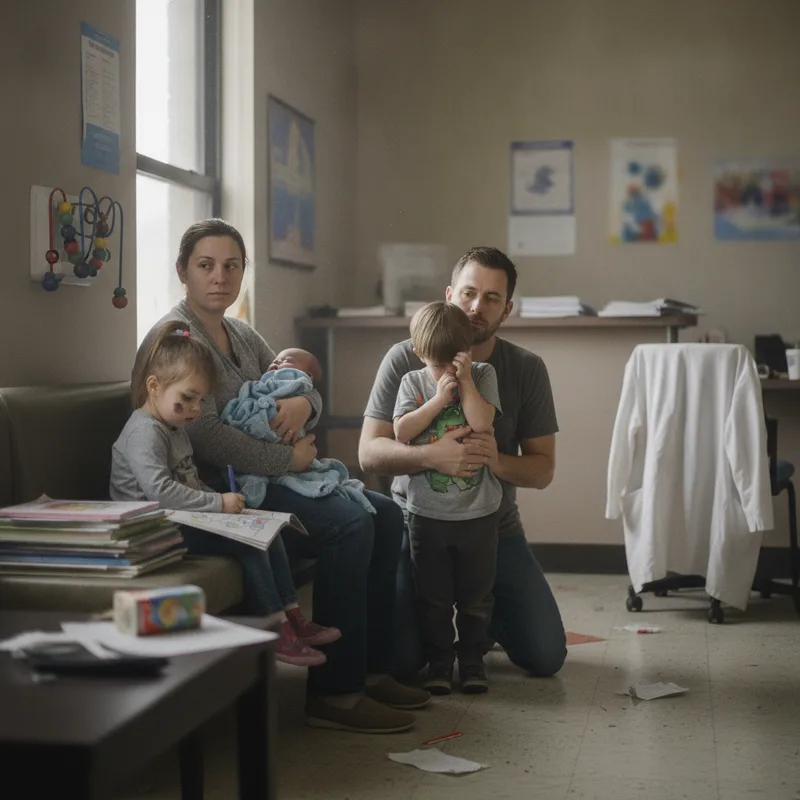
It is 7 p.m. on a Friday and your child has an earache, or it is Saturday morning and they just fell off the monkey bars. Where should you go? The right choice can save time and money and, in a true emergency, get help faster.
Start with a quick check
Before deciding where to go, ask yourself three questions:
- Is my child breathing normally?
- Is my child awake, alert and responding to me the way they usually do?
- Is my child able to drink and keep fluids down?
If the answer to any of these is no, your child likely needs urgent or emergency care, depending on how serious it looks. If the answer to all three is yes, there is usually time to call your pediatric office first and get advice.
Call your pediatric office first
For most illnesses and minor injuries, the best first step is a phone call to your child's pediatric office. Your pediatrician knows your child's history, medicines, allergies and vaccine record. Calling first often leads to:
- A same-day sick visit, so you skip the waiting room at urgent care
- Advice on caring for your child at home safely
- A clear answer about whether your child needs to be seen tonight or can wait until morning
- A referral to the right place, such as an ER or an X-ray, if your child needs more than an office visit
After hours
Many pediatric practices have an after-hours line, often answered by a nurse or an on-call clinician, for advice when the office is closed. They can help you decide whether your child needs care now, in the morning, or at home.
When the pediatric office is the right place
Your child's regular office is usually best for:
- Fevers in children over 3 months who are drinking and acting mostly normal
- Ear pain, sore throats and colds
- Pink eye and mild rashes
- Vomiting or diarrhea when your child is still drinking and peeing
- Follow-up after an ER or urgent care visit
- Ongoing conditions like asthma, ADHD, eczema or diabetes
- Medication refills, school forms and checkups
When urgent care makes sense
Urgent care is for problems that are not life-threatening but should not wait until your pediatric office opens. Examples include:
- A cut that might need stitches
- A sprain or a possible small broken bone, like a finger or toe, with no bone poking out and no bend in the limb
- Ear pain or sore throat at night or on the weekend
- Mild burns
- Minor allergic reactions with no trouble breathing or swallowing
Not every urgent care is set up for children. When you can, choose a pediatric urgent care, where staff are trained to care for babies and kids and have child-sized equipment. Many general urgent care centers mostly treat adults. Retail clinics in pharmacies and stores can be convenient for simple things like a flu shot, but they are generally not equipped for sick children. Ask the urgent care to send a visit summary to your pediatric office so we can follow up.
What about telemedicine?
Video visits can work well for simple problems you can see or describe, like pink eye, a mild rash, or a question about a medicine. They are less helpful when a child needs a hands-on exam, such as listening to the lungs, looking in the ears, or checking a belly. If you use telemedicine, choose a service with pediatric experience, preferably one connected to your child's pediatric office. The AAP does not recommend direct-to-consumer telehealth apps or retail clinics for children younger than 2, because illness in young children can change quickly and is harder to judge without an exam.
When to go to the ER
Go to the emergency room for serious problems that need fast care, tests or treatment, such as:
- A baby younger than 3 months with a temperature of 100.4°F or higher
- Trouble breathing, such as working hard to breathe, ribs pulling in with each breath, or wheezing that does not improve with a rescue inhaler
- Signs of serious dehydration, like no pee for 8 or more hours, a very dry mouth, no tears, or being unusually sleepy
- A head injury with vomiting, confusion, or unusual behavior
- A bone that looks bent or out of place, or an injured arm or leg that is cold, pale or numb
- Severe belly pain, especially in the lower right side or with a hard belly
- A cut that is deep, gaping or will not stop bleeding with pressure
- Swallowing a button battery, magnets, or a possible poison (also call Poison Control at 1-800-222-1222)
- Fever with a stiff neck, a rash that looks like small bruises or purple dots, or a child who seems very sick
If you can, choose an emergency department that treats children. In San Antonio, there are ERs focused on children, as well as general ERs that can stabilize a child and transfer them if needed.
When to call 911
Call 911 instead of driving yourself if your child:
- Is not breathing, is choking and cannot cough or speak, or is turning blue
- Is unconscious, very hard to wake, or limp
- Has a seizure that lasts more than a few minutes, or their first seizure
- Has a severe allergic reaction with trouble breathing or swelling of the face, lips or tongue
- Has a serious injury, such as from a car crash or a fall from a height, or a possible neck or back injury
- Has heavy bleeding that will not stop
Paramedics can start treatment on the way. Do not move a child with a possible neck or back injury unless they are in danger.
Be ready before you need it
Save your pediatric office and Poison Control numbers in your phone, know where the nearest pediatric urgent care and children's ER are, and keep a list of your child's medicines and allergies handy. The AAP's parent guide to urgent care, the ER or the pediatrician and its explanation of urgent care for children have more detail.
When to call us
When your child is sick or hurt and it is not an emergency, call your A thru Z Pediatrics office first. We can tell you whether to come in, where to go, or how to care for your child at home.
Call 911 or go to the ER for the emergencies listed above, or any time your gut tells you your child is seriously ill.
For a sick visit or a follow-up after urgent care or the ER, request a visit.
This article is general information, not medical advice. If you have concerns about your child's health, call your A thru Z Pediatrics office.