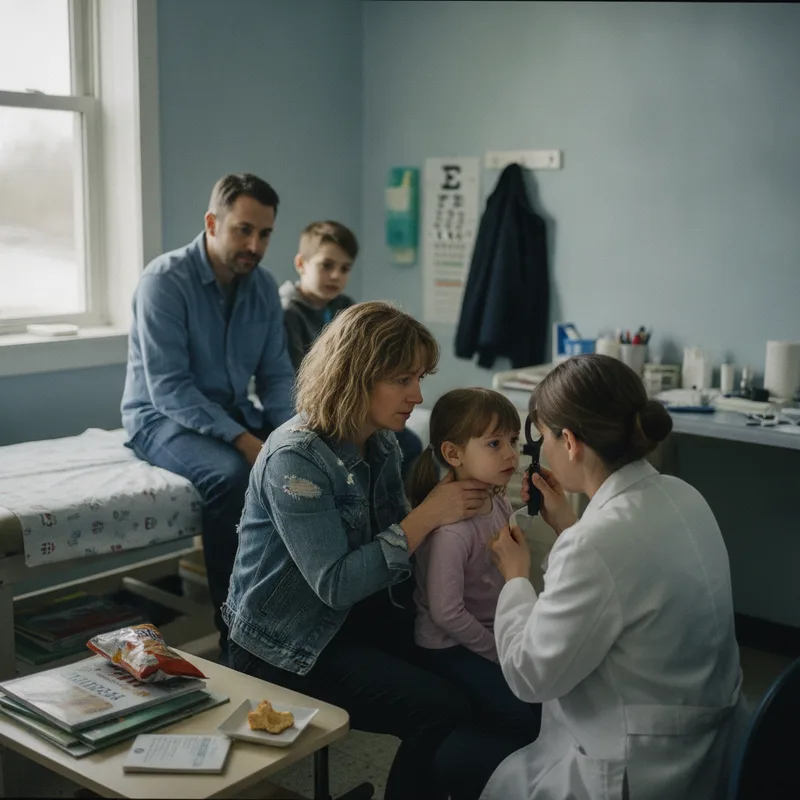
Children rarely complain that they cannot see well. If the world has always looked a little blurry, or one eye has always done most of the work, a child has no way of knowing anything is wrong. That is why vision checks are built into well-child visits from birth through the teen years. Finding eye problems early matters, because some of them are much easier to treat when a child is young. Here is what happens at each stage, what signs to watch for at home, and when to see an eye doctor.
Eye checks at checkups, by age
The American Academy of Pediatrics recommends eye checks at regular well visits, with the method changing as your child grows.
- Newborns and babies. Your pediatrician shines a light into the eyes to look for a "red reflex," the same red glow you sometimes see in photos. An abnormal reflex can be a sign of problems such as a cataract. The pediatrician also checks that the eyes look healthy, that the pupils respond to light and, as babies grow, that they can follow a face or toy.
- Ages 1 to 2 and up. Instrument-based screening may begin. These handheld devices, such as photoscreeners, use light and a camera to look for signs of focusing problems and misaligned eyes. Your child just needs to look at the device for a few seconds.
- Age 3 and older. Once children can cooperate, they read shapes, letters or symbols on an eye chart, one eye at a time. The AAP recommends this kind of visual acuity screening at ages 4 and 5, and in 3-year-olds who are able to do it.
- School-age children and teens. Vision screening continues at regular intervals at checkups. In Texas, there is also a state program for vision and hearing screening of school-age children, so your child may be screened at school as well.
A screening is not a full eye exam. If your child does not pass, it does not always mean something is wrong, but it does mean they should see an eye doctor.
Lazy eye and crossed eyes
Two of the most important problems screening looks for are amblyopia and strabismus.
Amblyopia (lazy eye)
Amblyopia happens when the brain and one eye do not work together properly during the years when vision is developing. The brain starts to favor the stronger eye, and the weaker eye's vision does not develop fully. The eye itself may look completely normal. Common causes include one eye being much more nearsighted or farsighted than the other, eyes that are not lined up, or something blocking vision, like a droopy eyelid or cataract.
Treatment works best when started early in childhood. It may include glasses, patching the stronger eye for part of the day or special eye drops, as prescribed by an eye doctor. Read more about amblyopia on MedlinePlus.
Strabismus (crossed or wandering eyes)
Strabismus means the eyes do not point in the same direction. One eye may turn in, out, up or down, all the time or only when your child is tired or looking at something close. It is common for a newborn's eyes to wander now and then in the first few months. After about 4 months, eyes that cross or drift should be checked. Strabismus can lead to amblyopia if it is not treated. Treatment may include glasses, patching, eye exercises or surgery. See MedlinePlus on strabismus.
Signs of a vision problem at home
Between checkups, watch for clues like these:
- Squinting, tilting the head or covering one eye to see
- Sitting very close to the TV or holding books and screens close to the face
- Frequent eye rubbing, headaches or eye strain, especially after reading
- Eyes that cross, turn or do not seem to move together
- A white, gray or yellow glow in the pupil in photos, or one red reflex and one that looks different
- Trouble with reading, losing their place or avoiding close work
- Bumping into things or clumsiness that seems new
- Very watery eyes, drooping eyelids or sensitivity to light
Screens and eyes
Many parents wonder whether screens harm children's eyes. Long stretches of close-up screen time can cause eye strain, dry eyes and tired eyes. Research also suggests that spending more time indoors on close work, and less time outdoors, is linked to a higher chance of nearsightedness. Some simple habits help:
- Take regular breaks. A common tip is to look at something far away for a short time every 20 minutes or so.
- Hold devices at a comfortable distance, not right in front of the face.
- Remind children to blink, and keep screens out of the bedroom at night.
- Encourage outdoor play every day. In San Antonio, shady parks in the morning or evening make this easier in summer.
- Protect eyes outdoors with sunglasses that block UV rays and a wide-brimmed hat.
When to see an eye doctor
Your pediatrician may refer your child to a pediatric ophthalmologist or optometrist if your child:
- Does not pass a vision screening or cannot be screened
- Has eyes that cross or wander after about 4 months of age
- Has an abnormal red reflex or a white glow in the pupil
- Has a family history of childhood eye problems, such as lazy eye, crossed eyes, childhood cataracts or eye cancer
- Was born very early or has a condition linked to eye problems
The AAP's guide to vision screenings for babies and children and the Texas DSHS vision, hearing and spinal screening program have more details.
When to call us
Call your A thru Z Pediatrics office if you notice any of the signs above, if your child did not pass a school screening, if your baby's eyes still cross after a few months, or if your child has red, itchy, swollen or goopy eyes.
Call 911 or go to the ER right away for a chemical splash in the eye (rinse with clean water while you get help), an object stuck in the eye, a serious eye injury, sudden loss of vision, or eye pain with swelling and fever. If a chemical gets in the eye, you can also call Poison Control at 1-800-222-1222 while you rinse.
For a checkup that includes a vision screening, request a visit.
This article is general information, not medical advice. If you have concerns about your child's health, call your A thru Z Pediatrics office.